
We Won at the Fifth Circuit: Lake Austin Homeowners' Case Revived
Our firm represents roughly 400 households who own property along Lake Austin. For seven years, they've lived with an open question hanging over their homes: whether the City of Austin could retroactively rewrite their jurisdictional status and start taxing them even though the City never provided them with full municipal services.
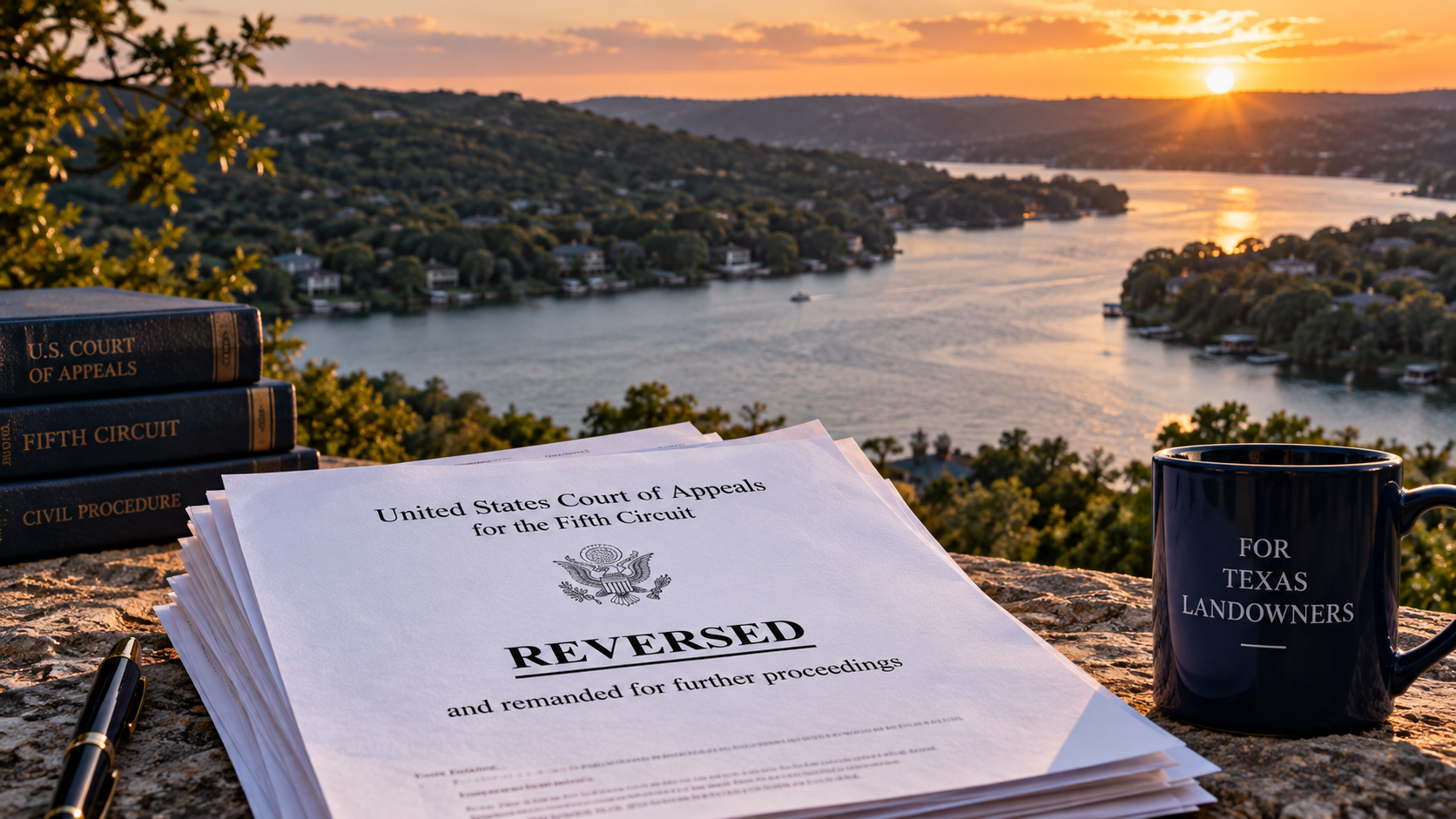
This week, the Fifth Circuit Court of Appeals ruled in our clients' favor, reversing the district court and sending the case back for a ruling on the homeowners’ claims.
How this started
In 1986, the City passed an ordinance placing these Lake Austin properties in its "limited purpose jurisdiction.” Under Texas law, this status means something: a municipality doesn’t have to provide full services to its limited-purpose areas; in return, the municipality cannot tax them.
But, in 2019, the City of Austin passed a new ordinance repealing the 1986 ordinance and declaring (dishonestly) that these properties had always been within its full-purpose jurisdiction since 1891. After using the 2019 ordinance to rewrite history, the City began taxing those properties.
The claim at the center of the case
Our clients' position is straightforward. Full-purpose residents pay full City taxes and therefore must receive full City services, including water, wastewater, fire protection, police protection, and so on. The City’s limited-purpose residents don’t receive all of those services and therefore don’t pay property taxes to the City.
The 2019 ordinance put our clients in the worst of both worlds: denied basic City services but still fully taxed.
That mismatch underpins the homeowners’ federal equal-protection claim, along with other claims under Texas annexation law.
Why the case had stalled
For years, the City's defense hasn't focused on the merits of the homeowners’ claims. Instead, the City has repeatedly convinced the district court not to decide the dispute at all.
Most recently, the district court held that unresolved questions of state law, including how to interpret the 1986 ordinance, should be resolved by a state court, not a federal court. Pullman abstention, which the district court applied, holds that state courts (rather than federal courts) should generally decide difficult and unsettled questions of state law when the answers would make it unnecessary to rule on the federal claims.
But the Fifth Circuit reversed the district court’s decision to apply the Pullman doctrine. The Fifth Circuit explained that the homeowners’ equal-protection claims don’t depend on how the 1986 ordinance is interpreted. Whatever that ordinance means, it doesn't answer the separate question of whether the City can tax the homeowners’ properties while failing to provide them with the full municipal services it provides to other residents.
The Fifth Circuit also rejected the City's argument that a new state law—S.B. 1844—made the whole case moot. It doesn't. Even though the new law allows the homeowners to disannex their land from the City, they cannot get tax refunds under the new law. Instead, they must seek refunds in their tax-protest lawsuit against the Travis Central Appraisal District. Further, the City has rejected some of the homeowners’ disannexation petitions. As the Fifth Circuit explained, “[t]he Homeowners therefore retain a financial stake in the validity of the 2019 Ordinance.”
What the ruling actually does
The Fifth Circuit sent the case back to the district court with clear instructions: decide all of the City's remaining non-merits defenses together this time, rather than ruling on one, getting reversed, and starting over on the next one. That should mean fewer trips back and forth between courts—and a faster path to an actual decision on the merits.
What's next
The case now returns to the district court, where several remaining procedural arguments still need to be resolved before the homeowners’ underlying claims are decided.
But, as one of the Fifth Circuit judges suggested in the previous appellate argument, the City “won’t have a legal leg to stand on” when this case gets to the merits. This decision gets us one big step closer to that day.