
Remainder Damages: The Part They Pay For, and the Part They Pretend Doesn't Exist
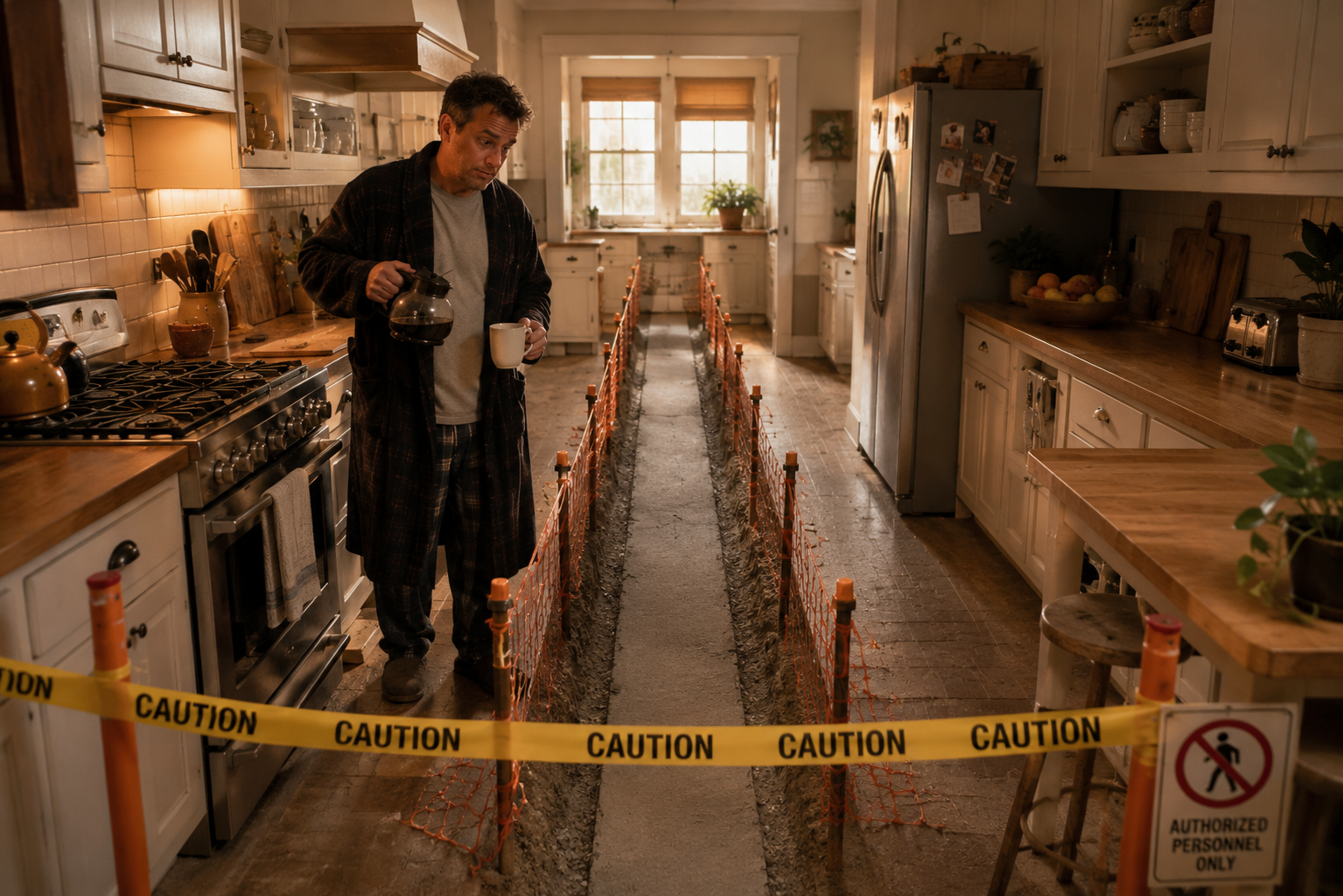
Imagine a man knocks on your door one morning with a clipboard and the calm, polite smile of someone who’s about to say something insane.
"Good news," he says. "We've selected your house."
His company, he explains, needs a three-foot strip running straight through the middle of it: right through the living room, across the kitchen, between the stove and the refrigerator, splitting your breakfast routine in half. There will be a small fence. Possibly some signage.
"But don't worry," he adds. "We'll pay full market price for that three-foot strip." He shows you the math: a price per square foot, very official, very fair, but just for the strip.
Then he's gone. And you're left standing in a house where getting from the couch to the coffee maker now requires a detour, where you can't renovate over the corridor or build across it, and where every future buyer stops in the doorway and asks the same question: “What's that?”
Here's the thing: the man's price per square foot might have been exactly right. But nobody buys a house one square foot at a time. People buy a whole home, excited to have a place to call their own. But with that obnoxious three-foot stripe running through your home, what you own now isn't quite a house anymore. It's two halves of one, with a stranger's corridor in between.
That's exactly what happens in eminent domain cases every day. You haven’t just lost a three-foot strip. The fact that the three-foot strip exists makes your entire house less valuable. This kind of loss has a legal name: remainder damages. And it's the single biggest reason the first offer in a pipeline or electric-transmission-line case is almost never a fair offer.
The taker’s offer covers the strip, not the real damages.
When a condemnor makes its first offer, this offer usually covers only the land that's actually being taken or that has an easement on it—the strip where the pipeline goes in, the corridor where the transmission line runs and the big towers stand, or the right-of-way for the new road.
In a lot of cases, the taker actually pays a fair amount for that strip. But that's usually not where the big fight is.
The big fight is over the land you still own. Lawyers call it the remainder, and here's what the condemnor's offer conveniently ignores. Once a pipeline runs through the middle of your ranch, or transmission towers march across your back forty, the value of that remaining property is often worth much less than it was before. That loss in value is what remainder damages are. And, in most cases, the remainder damages far exceed the value of the strip that’s taken.
Why does the rest of your land lose value?
Think about what a buyer sees after the taking.
First, the property that used to be one usable piece is now split into two. A tract you could develop, farm, or sell as a whole is now two awkward pieces with a permanent easement between them, and awkward pieces sell for less.
Second, you may lose the buyer you never got to meet. A developer who would have been interested in the whole tract may not want to deal with asking the pipeline or electric company for permission to build roads or install utilities across the easement.
Third, the buyer sees that it won’t have privacy or the ability to keep others off the land, as the pipeline and transmission-line companies can enter anytime to do inspections or maintenance of their lines.
Fourth, there are environmental and safety risks associated with living next to high-pressure gas and high-voltage electric lines. You can debate how big those risks are. The market doesn't debate. Buyers price those risks into their offers, resulting in lower sales prices for land burdened by these kinds of easements.
These damages are not about hurt feelings. These are real losses that real buyers and sellers price into real negotiations. If the market says your remaining 190 acres are worth less because of what now runs through them, those losses are just as real as the value of the strip they took.
Condemnors know this. They just hope you don't.
How big can the difference be?
One of our lawyers worked on a case in which the pipeline company’s final offer was $79,979. That number represented the value of the actual easement strip that was taken. But the pipeline company and its appraiser contended the pipeline easement caused no damage to the value of the landowner’s remaining property.
The jury's verdict recognized that the pipeline easement reduced the value of the remaining land, awarding $1,633,000 in just compensation. That was more than 20 times the pipeline company’s final offer.
And here's something a lot of landowners don't know: in Texas courts, you have the right to a jury trial on the value of your property. Not a bureaucrat's number. Not the number from the appraiser hired by the taker. You have the right to a jury of your neighbors, deciding what was actually lost. You don't always have that right in other courts—but you do in Texas.
A word about “winning” . . .
I've sat across the table from hundreds of landowners over more than 20 years of doing this work.
Even when the check is 20 times more than the condemnor’s final offer, plenty of people still feel they lost. The land is still taken. The pipeline, road, or electric line is still there. Money doesn't un-split a ranch that's been in your family for generations.
What I can tell you is this: If the taking is going to happen, then the fight worth having is making sure the condemnor pays for everything it took. Not just the strip. The whole loss. The reduced value of your house, not just the square-foot value of the three-foot strip.
Here’s a question to ask if you've received an offer.
If a condemnor has made you an offer, ask one question before anything else: Does this number account for what will happen to the rest of my land?
For almost every first offer I've ever seen, the answer is “no.” And that's exactly why we talked about the marshmallow. The first offer is a test of patience, and the damages to your remaining property are usually what’s missing from it.
That's a conversation worth having with someone who does this every day. It costs you nothing to ask. Not asking is far more costly.